LATHAM, NY — The New York Army National Guard ranked first in recruiting and retention among the 10 states with the largest Army National Guards during fiscal 2026, according to statistics released by the National Guard Bureau.
Georgia and Florida finished second and third, respectively, in the large-state category.
New York also outperformed California and Texas, which have the largest and second-largest Army National Guards among the 54 states and territories.
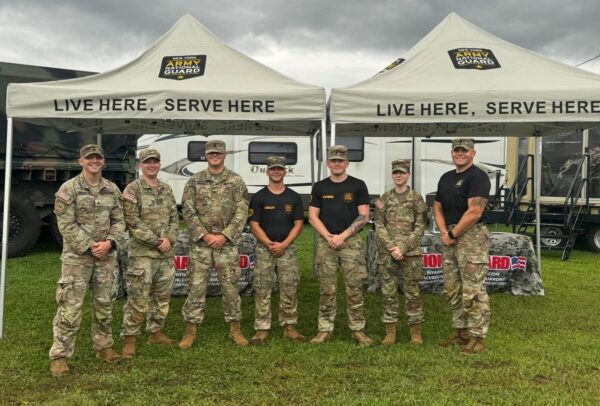
[Photo above: New York Army National Guard recruiters and Soldier recruiting volunteers at the Washington County Fairgrounds in Greenwich, NY, on August 25, 2026. The recruiting team, based at the armory in Queensbury, NY, spoke with fairgoers about careers in the New York Army National Guard. (Photo by Staff Sgt. Andrew Valenza)]
With 12,019 Soldiers at the end of fiscal 2026, New York had the nation’s fourth-largest Army National Guard, behind Pennsylvania.
During the fiscal year, which ran from Oct. 1, 2025, through Sept. 30, New York Army National Guard strength increased by 319 Soldiers, or 2.7%, from approximately 11,700 Soldiers at the end of fiscal 2025.
The New York Army National Guard recruited 1,929 personnel during fiscal 2026, including 1,768 enlisted Soldiers, 105 basic branch officers, 35 warrant officers and 21 specialty officers — 12 medical service officers, seven chaplains and two judge advocate general officers.
The total was slightly lower than fiscal 2025, when New York Army National Guard recruiters brought in 2,065 Soldiers.
The 35 warrant officer accessions marked a record for New York, according to Lt. Col. John Harder, commander of the New York Army National Guard Recruiting and Retention Battalion.
The New York Army National Guard also reenlisted 2,123 Soldiers during the fiscal year, setting another state record, Harder said.
According to National Guard Bureau statistics, New York ranked first nationally in enlisted recruiting and retention during fiscal 2026.
The Army National Guard evaluates each state’s recruiting and retention performance using a weighted point system based on enlisted recruiting, officer recruiting, personnel losses and retention. Each factor is weighted according to its importance to maintaining force strength and mission readiness.
New York scored 130.22 points, while Georgia, which finished second in the large-state category, scored 117.23.
In fiscal 2025, New York ranked first overall among all 54 states and territories in recruiting and retention. In fiscal 2026, the District of Columbia ranked first overall with a weighted score of 131.
Harder said the 278 members of the New York Army National Guard’s Recruiting and Retention Battalion faced a “myriad of challenges” during fiscal 2026.
The federal government shutdown from Oct. 1 to Nov. 12, 2025, limited recruiters’ ability to perform their duties and delayed the hiring of new full-time recruiters, Harder said.
A federal hiring freeze in 2025 also made it more difficult to hire civilian employees, he said.
Despite these challenges, New York Army National Guard recruiters “achieved record breaking numbers in accessions and achieved the highest number of reenlistments in this battalion’s history,” Harder said.
“I am tremendously proud of our recruiters, career counselors, officer recruiters and the entire battalion for navigating this challenging year and ending on top,” he added.
Brig. Gen. Patrick Clare, the New York National Guard’s assistant adjutant general for Army, attributed the recruiting force’s success to its strong community connections.
“They are deeply embedded in New York’s communities,” Clare said.
“They genuinely care about the young men and women they mentor, and they show prospective Soldiers how serving in the Guard directly invests in their future; whether through college tuition, career skills or leadership development,” Clare added.
Clare said retaining experienced Soldiers is just as important as recruiting new Guard members.
“Keeping experienced Soldiers in uniform preserves institutional knowledge, strengthens our noncommissioned officer corps and builds cohesive teams that are ready to deploy,” he said.